Introduction
Every second, millions of financial transactions take place around the world.
A customer pays for coffee using a debit card.
A business pays an overseas supplier.
An investor purchases Bitcoin.
A traveller exchanges Pounds for Euros.
A company settles payroll across multiple countries.
Although these transactions appear simple, they all rely on one critical element working silently behind the scenes:
Liquidity.
Without liquidity, financial systems slow down, prices become unstable, and transactions become expensive or even impossible.
Whether in traditional finance or digital finance, liquidity is what keeps money moving efficiently throughout the global economy.
In this module, you'll learn what digital liquidity markets are, why they matter, and how they support the financial services we use every day.
What Is Liquidity?
Liquidity refers to how easily an asset can be bought, sold, or exchanged without significantly affecting its price.
A highly liquid market allows buyers and sellers to trade quickly because there are enough participants on both sides.
For example:
- Cash is considered highly liquid because it can be spent immediately.
- Shares in a large public company are generally liquid because many people are willing to buy and sell them.
- Property is much less liquid because selling a house often takes weeks or months.
Digital assets operate under the same principle.
For a digital asset to be useful, there must be enough liquidity available for people to exchange it whenever they choose.
Why Liquidity Matters
Imagine walking into a supermarket where every shelf is empty.
Even if you have money, you cannot purchase what you need because nothing is available.
Financial markets work in a similar way.
Without sufficient liquidity:
- Trades become slower.
- Prices fluctuate dramatically.
- Buyers cannot find sellers.
- Sellers cannot find buyers.
- Transaction costs increase.
- Confidence declines.
Liquidity allows markets to function smoothly by ensuring that assets can move efficiently between participants.
Traditional Markets vs Digital Markets
Traditional financial markets have existed for hundreds of years.
Examples include:
- Foreign exchange (Forex)
- Stock exchanges
- Bond markets
- Commodity markets
Digital markets are newer but operate on similar principles.
Examples include:
- Cryptocurrency exchanges
- Digital payment networks
- Stablecoin ecosystems
- Decentralised finance (DeFi) platforms
While the technology differs, both traditional and digital markets depend on liquidity to operate efficiently.
What Is a Digital Liquidity Market?
A digital liquidity market is an environment where digital assets are continuously exchanged between participants.
These participants may include:
- Individual users
- Professional traders
- Institutions
- Payment companies
- Financial technology providers
- Market makers
- Liquidity providers
Together, these participants help maintain active markets where assets can move efficiently throughout the global financial system.
Who Uses Digital Liquidity?
Liquidity is required by many different organisations.
Examples include:
Cryptocurrency Exchanges
Exchanges require liquidity so users can buy and sell digital assets quickly.
Payment Providers
Digital payment companies rely on liquidity when moving funds between currencies and countries.
Financial Institutions
Banks and financial firms increasingly explore digital assets for settlement, payments, and tokenised financial products.
Businesses
Companies accepting digital payments require efficient conversion between different digital assets and traditional currencies.
Individual Users
Every person transferring, swapping, or purchasing digital assets benefits from strong market liquidity.
What Happens During a Digital Asset Transaction?
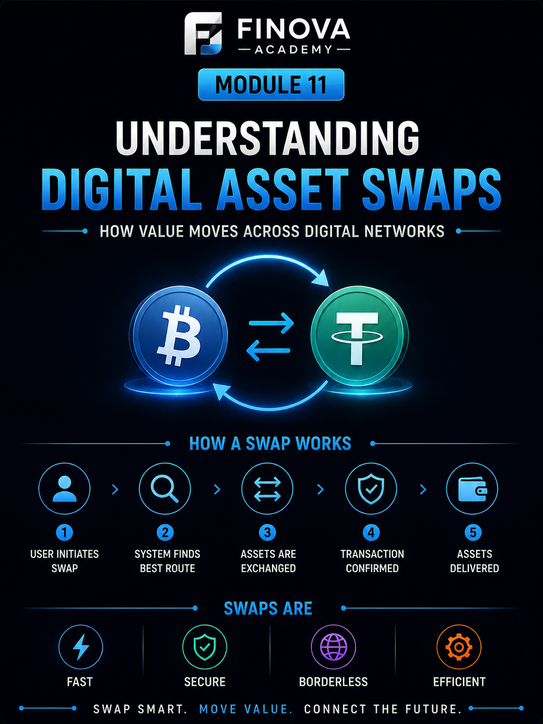
Although each platform operates differently, a typical transaction generally follows these stages:
- A user submits a transaction.
- The system searches for available liquidity.
- The transaction is matched using available market participants.
- Settlement occurs.
- Assets are delivered to the recipient.
The entire process often completes within seconds, although settlement times vary depending on the network and service being used.
Why Is Liquidity Sometimes Fragmented?
Unlike traditional financial markets, digital assets exist across many different ecosystems.
For example:
- Multiple exchanges
- Different blockchains
- Various stablecoins
- Numerous trading platforms
- Different liquidity pools
Instead of one central marketplace, liquidity is distributed across many independent networks.
This creates fragmentation.
Fragmented liquidity can lead to:
- Different prices between platforms
- Higher transaction costs
- Slower execution
- Reduced efficiency
Connecting liquidity across multiple environments has therefore become an important focus for many financial technology providers.
Liquidity Providers
Liquidity providers help ensure markets continue operating efficiently.
Their role is to support active markets by contributing available liquidity that allows transactions to occur more smoothly.
Healthy liquidity generally contributes to:
- Better pricing
- Faster execution
- Reduced volatility
- Improved market efficiency
- Better user experience
Liquidity providers play an important role across both traditional and digital financial markets.
Market Makers
You may also hear the term market maker.
While the responsibilities vary between markets and jurisdictions, market makers generally help maintain active trading by continuously quoting prices for buying and selling assets.
Their participation helps improve market efficiency by encouraging continuous trading activity.
Why Efficient Liquidity Benefits Everyone
When liquidity functions efficiently:
- ✔ Transactions complete more quickly
- ✔ Prices remain more consistent
- ✔ Market confidence improves
- ✔ Businesses can operate more efficiently
- ✔ Payment systems become more reliable
- ✔ Users enjoy a smoother experience
Strong liquidity supports healthier financial ecosystems for everyone involved.
Challenges Facing Digital Liquidity
Although digital finance has grown rapidly, several challenges remain.
These include:
- Fragmented markets
- Network congestion
- Different blockchain standards
- Varying settlement mechanisms
- Regulatory differences between countries
- Security considerations
- Scalability as adoption increases
The industry continues developing new technologies to improve efficiency while maintaining security and transparency.
Why This Matters
Most people never think about liquidity.
Yet almost every digital financial service depends on it.
Whether someone is:
- Sending money overseas,
- Purchasing digital assets,
- Making an online payment,
- Trading on an exchange,
- Or using blockchain-based applications,
liquidity is working behind the scenes to make those transactions possible.
Understanding liquidity provides a deeper appreciation of how today's digital economy operates and why efficient financial infrastructure is essential for global commerce.
Key Takeaways
Before moving to the next module, remember these important concepts:
- Liquidity allows assets to be exchanged efficiently.
- Strong liquidity supports faster and more stable markets.
- Digital liquidity markets connect buyers, sellers, businesses, and institutions.
- Liquidity exists across many exchanges and blockchain networks.
- Fragmented liquidity presents operational challenges.
- Liquidity providers help improve market efficiency.
- Modern digital finance depends on reliable liquidity infrastructure.
Congratulations on completing Module 9.
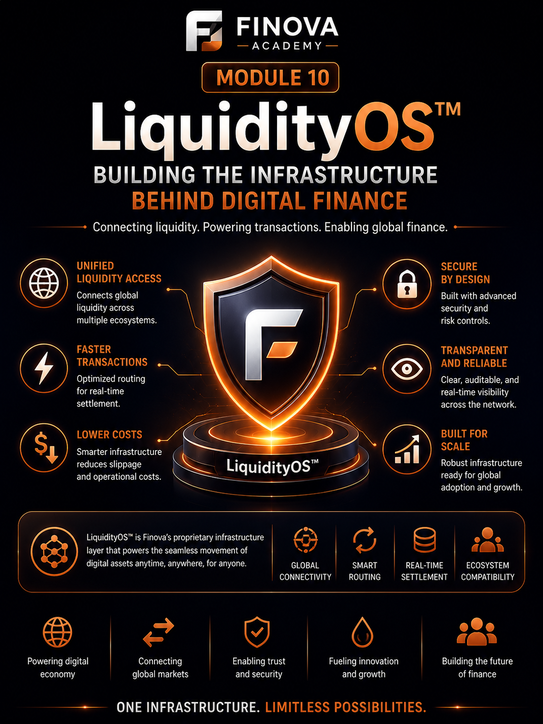
In Module 10, you'll learn how financial infrastructure can help coordinate liquidity across modern digital environments and why infrastructure plays a critical role in supporting the future of digital finance.