Introduction
Every modern city relies on infrastructure.
Roads allow vehicles to move efficiently.
Power grids deliver electricity to homes and businesses.
Water pipelines provide clean water to millions of people every day.
The internet connects people and businesses across the globe.
Most people rarely think about these systems because they simply work.
Digital finance is no different.
Behind every payment, digital asset transfer, currency exchange, or blockchain transaction lies a complex network of technology working continuously behind the scenes.
This invisible layer is known as financial infrastructure.
LiquidityOS™️ was designed around one simple philosophy:
«Financial innovation should be supported by reliable infrastructure that enables digital liquidity to move more efficiently, transparently, and at scale.»
This module introduces the role of LiquidityOS™️, how infrastructure supports digital finance, and why efficient liquidity management has become increasingly important in today's digital economy.
What Is Financial Infrastructure?
Infrastructure refers to the systems that allow an economy to function.
In traditional finance, infrastructure includes:
- Banking networks
- Payment processors
- Clearing houses
- Settlement systems
- Foreign exchange networks
- Card payment systems
These systems ensure that money moves securely and efficiently between individuals, businesses, and institutions.
Digital finance requires a similar foundation.
Instead of only supporting traditional currencies, digital financial infrastructure must also support blockchain networks, digital assets, payment technologies, and cross-platform interactions.
Why Digital Finance Needs Better Infrastructure
The digital asset industry has expanded rapidly.
Today there are:
- Thousands of digital assets
- Hundreds of exchanges
- Multiple blockchain networks
- Numerous payment providers
- Various settlement mechanisms
- Different liquidity sources
Each platform often operates independently.
As adoption grows, connecting these systems efficiently becomes increasingly important.
Without effective infrastructure:
- Liquidity becomes fragmented.
- Transactions may become less efficient.
- Settlement processes become more complex.
- Users experience inconsistent pricing and execution.
Infrastructure helps organise these moving parts into a more coordinated ecosystem.
Introducing LiquidityOS™️
LiquidityOS™️ is a digital financial infrastructure designed to support the coordination and management of liquidity across modern digital financial environments.
Rather than acting as a trading platform itself, LiquidityOS™️ focuses on the infrastructure that helps support liquidity-related operations.
Its objective is to improve efficiency by helping organise how liquidity resources are managed within participating digital ecosystems.
Think of LiquidityOS™️ as the operating layer that helps connect infrastructure rather than replacing existing financial platforms.
An Easy Way to Understand LiquidityOS™️
Imagine an international airport.
Passengers arrive from different countries.
Airlines operate independently.
Different terminals handle different flights.
Security, immigration, baggage handling, and scheduling all work together behind the scenes.
Passengers may only see their departure gate, but a sophisticated infrastructure coordinates everything required for a successful journey.
LiquidityOS™️ follows a similar philosophy.
Rather than replacing individual platforms, it focuses on helping infrastructure operate more efficiently behind the scenes.
Core Principles of LiquidityOS™️
LiquidityOS™️ is built around several key principles.
Infrastructure First
Strong infrastructure supports long-term growth.
Instead of focusing only on individual transactions, LiquidityOS™️ emphasises building systems that can support increasing levels of digital financial activity over time.
Efficiency
Modern financial systems require efficient coordination.
By improving operational workflows, infrastructure can help reduce unnecessary complexity and improve overall performance.
Transparency
Transparency strengthens confidence.
Where appropriate, blockchain technology enables transaction records that can be independently verified, supporting greater visibility within digital financial systems.
Scalability
As adoption increases, infrastructure must be capable of supporting higher transaction volumes without sacrificing reliability.
Scalable infrastructure is essential for long-term ecosystem growth.
Adaptability
Technology evolves quickly.
Financial infrastructure should be designed with flexibility so it can continue adapting as new technologies, blockchain networks, and financial innovations emerge.
How LiquidityOS™️ Fits into the Digital Economy
Digital finance involves many participants.
These may include:
- Users
- Payment providers
- Digital asset platforms
- Exchanges
- Wallet providers
- Financial technology companies
- Liquidity providers
Each participant performs a different function.
Infrastructure helps create an environment where these participants can interact more efficiently.
Rather than operating in isolation, infrastructure enables smoother coordination across the broader digital financial ecosystem.
The Importance of Liquidity Coordination
Liquidity exists across many different environments.
Different exchanges often have different prices.
Different blockchain networks operate independently.
Settlement methods vary.
Available liquidity changes continuously.
Infrastructure helps organise these moving parts so digital financial services can operate more efficiently.
While every transaction follows its own unique path, effective coordination contributes to a more consistent user experience.
Supporting Transparency
One of blockchain's greatest strengths is transparency.
Many blockchain transactions can be independently verified using publicly available records.
This helps create:
- Greater visibility
- Improved accountability
- Better auditability
- Increased confidence in recorded transactions
Infrastructure that embraces transparency contributes to stronger trust across digital ecosystems.
Supporting Future Innovation
Digital finance continues to evolve.
New technologies are emerging, including:
- Stablecoins
- Tokenised real-world assets
- Artificial intelligence
- Cross-chain interoperability
- Digital identity solutions
- Smart contract automation
Future financial infrastructure must be capable of supporting innovations that may not yet exist.
Infrastructure should therefore be designed with flexibility and long-term development in mind.
Why Infrastructure Matters More Than Ever
As digital finance becomes increasingly global, reliable infrastructure becomes even more important.
Effective infrastructure can help support:
- Greater operational efficiency
- Improved coordination
- Better scalability
- Increased transparency
- Enhanced user experiences
- Sustainable ecosystem growth
Although users may never directly interact with financial infrastructure, it plays a vital role in enabling the services they rely on every day.
Looking Ahead
The future of digital finance will not be shaped by a single application or technology.
It will be built upon interconnected systems working together to support a growing digital economy.
Infrastructure provides the foundation upon which innovation can continue to develop.
By focusing on efficiency, transparency, scalability, and long-term sustainability, infrastructure platforms aim to help support the next generation of digital financial services.
Key Takeaways
Before moving to the next module, remember these important concepts:
- Financial infrastructure powers digital finance behind the scenes.
- LiquidityOS™️ is designed as infrastructure rather than a consumer trading platform.
- Infrastructure helps coordinate digital liquidity across complex ecosystems.
- Efficiency, transparency, scalability, and adaptability are key design principles.
- Modern digital finance depends on strong infrastructure to support long-term growth.
- Users often don't see infrastructure, but they benefit from it every time they use digital financial services.
Congratulations on completing Module 10.
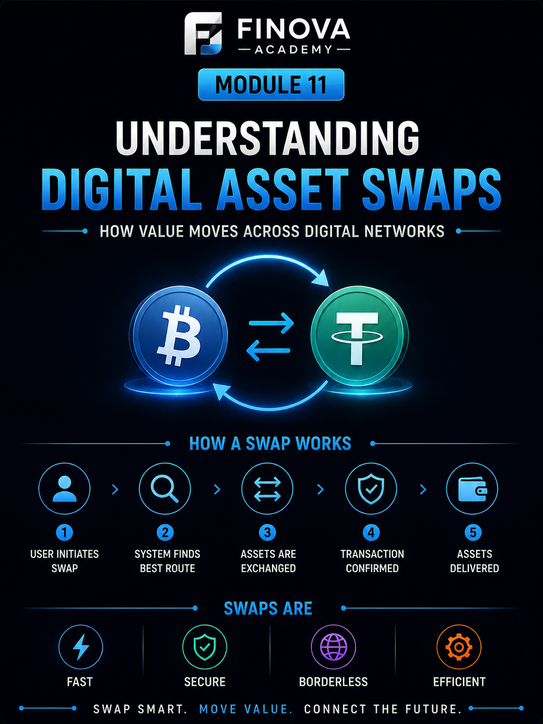
In Module 11, we'll explore how digital assets are exchanged, what happens during a swap, and why efficient routing and liquidity are essential to keeping the digital economy moving.